


AI Overviews, ChatGPT, and Perplexity Are Reshaping B2B Discovery
Engineer a page for a human reader in 2020, and a search engine found it anyway. That relationship is breaking down. Google now answers most searches directly on the results page. ChatGPT and Perplexity answer them before a search engine is ever involved. For B2B businesses, this changes who sees your content, when they see it, and whether they click through at all. The data below shows how far the shift has already gone, and why the old advice about "adding FAQ schema" and calling it a day falls short of what these systems actually reward.
Google Users Have Mostly Stopped Clicking Through
Pew Research Center analyzed the browsing activity of 900 U.S. adults in March 2025 and published the findings in July 2025. About 58% of participants ran at least one Google search that month that returned an AI Overview. The behavior difference was stark: users clicked a traditional search result in just 8% of visits when an AI Overview appeared, compared with 15% when it did not. Users clicked a link inside the AI summary in only 1% of visits. They were also more likely to end the session entirely after seeing a summary (26% of the time, versus 16% without one).
Pew's data also points to which searches trigger a summary in the first place. Just 8% of one- or two-word searches produced an AI Overview. That share jumped to 53% for searches of 10 words or more. Questions that opened with "who," "what," "when," or "why" produced a summary 60% of the time. Full-sentence searches, meaning queries with both a noun and a verb, produced one 36% of the time.
The pattern is consistent. Google's generative features are built to answer the kind of specific, spelled-out questions that B2B buyers ask when they are further along in evaluating a solution, and those are exactly the searches where clicking through to a website has turned into a rare event.
B2B Buyers Are Already Living Inside Answer Engines
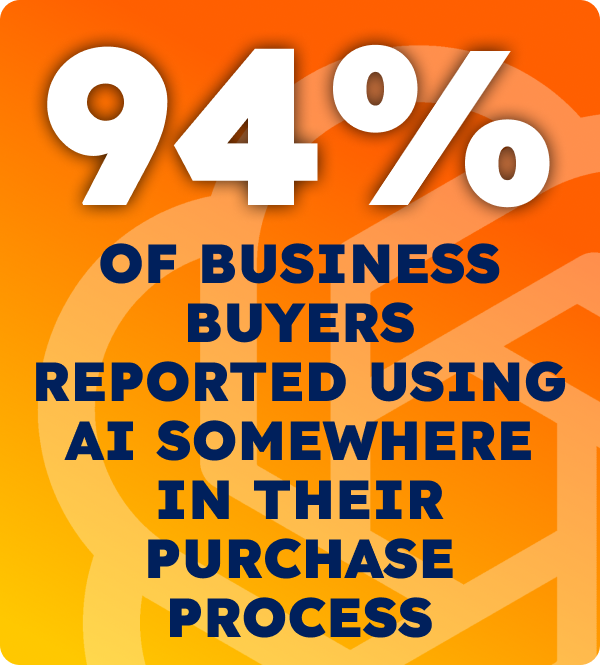
This shift is not limited to Google. In Forrester's Buyers' Journey Survey, published January 2026, 94% of business buyers reported using AI somewhere in their purchase process, up from 89% the year prior. More striking: twice as many buyers named generative AI or conversational search as their single most valuable source of information, ahead of vendor websites, product experts, and sales reps combined. Sixty-one percent said they use a private AI tool supplied by their own employer, and Forrester found business buyers are twice as likely to use ChatGPT, and four times as likely to use Microsoft Copilot, as consumers.
The scale behind those numbers is real. OpenAI reported in February 2026 that ChatGPT had crossed 900 million weekly active users, up from roughly 400 million a year earlier. Perplexity's CEO shared onstage at a Bloomberg summit in June 2025 that the platform had processed 780 million queries the prior month. These are no longer emerging tools. For a large and growing share of B2B buyers, they are the starting point for vendor research, well before anyone fills out a contact form.
Forrester's own recommendation is direct: shift from driving traffic through search engine optimization alone to driving visibility through what the industry calls answer engine optimization, or AEO. That means treating your brand's presence inside an AI-generated answer as seriously as its position on a results page.
"Structured" Content Does Not Mean FAQ Schema
Here is where a lot of AEO advice circulating right now gets it wrong. The common shortcut is to bolt FAQ schema markup onto existing pages and call it optimized for AI. The data does not support that shortcut.
Google's own guide to optimizing for generative AI features states plainly that structured data is not required for generative AI search and that there is no special schema.org markup a site needs to add. Google's guidance instead points to organizing content in a way that helps human readers: clear paragraphs, clear headings, and a genuine point of view rather than a summary of what is already published elsewhere.
Ahrefs tested this directly. In a study published in May 2026, the company tracked 1,885 pages that added JSON-LD schema between August 2025 and March 2026 and compared them against matched control pages. Adding schema produced no meaningful citation gain on Google AI Mode or ChatGPT, and a small, unexplained decline on Google AI Overviews. A related test cited in that research found that ChatGPT, Claude, Perplexity, Gemini, and Google AI Mode all ignored JSON-LD and hidden markup entirely during real-time retrieval. Every one of those systems read only the visible content on the page.
The real lever is the visible content itself. "Structured" means the page is organized around the actual questions a buyer is asking, in language a person (and a model reading on that person's behalf) can lift out and cite directly. It means an early, direct answer instead of three paragraphs of throat-clearing before the point. It means unique, first-hand expertise instead of a recap of what a dozen competitors already published. Question-driven content works as a writing discipline, applied page by page, rather than a tag added after the fact.
Build Content Designed to Be Found, and Cited
For B2B businesses, the practical shift looks like this: map the real, specific questions your buying group asks at each stage, from an initial researcher to a finance stakeholder validating the deal. MoJo Active's approach to B2B lead generation starts from that same premise, since a long sales cycle with multiple stakeholders means a lot of different questions need direct, credible answers along the way.
From there, the work splits into two disciplines that reinforce each other. On-page content needs to be organized to answer those questions clearly, which is the same foundation behind strong search engine optimization. And the content itself, whether a comparison page, a benchmark, or a detailed guide, needs the kind of original perspective that content creation built around real expertise can provide, rather than a rewrite of what is already indexed.
Layer AI on top of that foundation instead of treating it as a replacement for the work. MoJo Active's AI-driven marketing services help brands identify where buying signals are showing up and act on them at the right moment, so the content built for answer engines connects to the campaigns built to reach the humans behind the questions.
Google Overviews, ChatGPT, and Perplexity have already changed how your buyers look for you. The brands that adapt their content now will be the ones an AI answer actually names.
Contact MoJo Active to talk through what this shift means for your content and search strategy.
Done Right, You Keep Your Data
A one-size-fits-all banner that applies strict opt-in rules to every visitor blocks your marketing pixels by default, even in states where you're legally permitted to track. Since most visitors never actively click accept, that setup quietly surrenders conversion and retargeting data you had every right to collect. Geo-aware configuration applies opt-in only where the law requires it, and the opt-out model where that's the standard. Paired with Google Consent Mode and analytics tags configured to respect it, you retain modeled conversion data even from visitors who decline.
What "Done" Actually Looks Like
- Reviewing your existing tracking implementation
- Configuring the consent platform for your specific state and signal requirements
- Updating tags across every marketing platform, from Google Analytics and Google Ads to Meta, Klaviyo, and LinkedIn
- Implementing Google Consent Mode
- Testing across browsers and devices
- Validating that tracking only fires after the appropriate consent is granted
- Documenting every configuration so your compliance posture stays transparent over time
Bottom Line
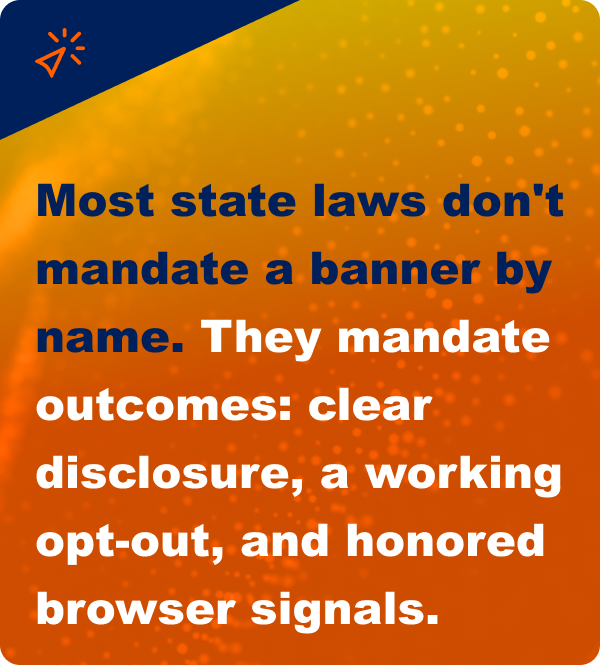
Most state laws don't mandate a banner by name. They mandate outcomes: clear disclosure, a working opt-out, and honored browser signals. A properly configured, monitored, and documented consent setup is the clearest way to deliver all three while protecting the marketing data your business runs on.
If you're not sure where your site actually stands, we're happy to take a look. Contact MoJo Active to review your current setup.
This post is general information, not legal advice. Confirm your specific obligations with qualified privacy counsel.