


Introducing Sprout
Your best copywriter looks at a headline and knows, in about four seconds, exactly what is wrong with it and what it should say instead.
Then those four seconds turn into a comment in a document, a line on a status call, a ticket somebody else writes, and finally a version of the instruction with half the intent missing. If it survives all of that, the change lands next week.
None of that had anything to do with the idea. All of it was the distance between the person who knew and the work itself.
On September 1, 2026, MoJo Active introduced Sprout, which removes that distance.
The Question Underneath AI Is Not What It Can Create
The last two years already answered what AI can create. It can make almost anything, quickly, and it keeps getting better at it every month.
The question nobody has solved is who is telling it what to create.
In most companies, the direction comes from whoever is most comfortable with the tools rather than whoever knows the work best: the designer with the eye, the strategist who knows the customer, the writer who can hear when a sentence is off. Their direction still travels by brief, by ticket, and by meeting before anything gets built. But every one of those steps costs a little of the original intent.
Sprout is built on a simple correction. The expert gives the direction, in their own words, on the work itself. Nothing in between.

Three Moves:
Direct, Create, Deliver
Direct. The expert who knows the work says what should change, right where they see it, the moment they notice. No ticket format, no brief, no translation step. Up to six captures, cropped and drawn on, mean nobody has to spell out what they meant.
Create. The AI your team already uses picks up that instruction with full context and creates the work. Copy, a layout, a campaign asset, a feature. Nothing was left to guess at, so nothing comes back generic.
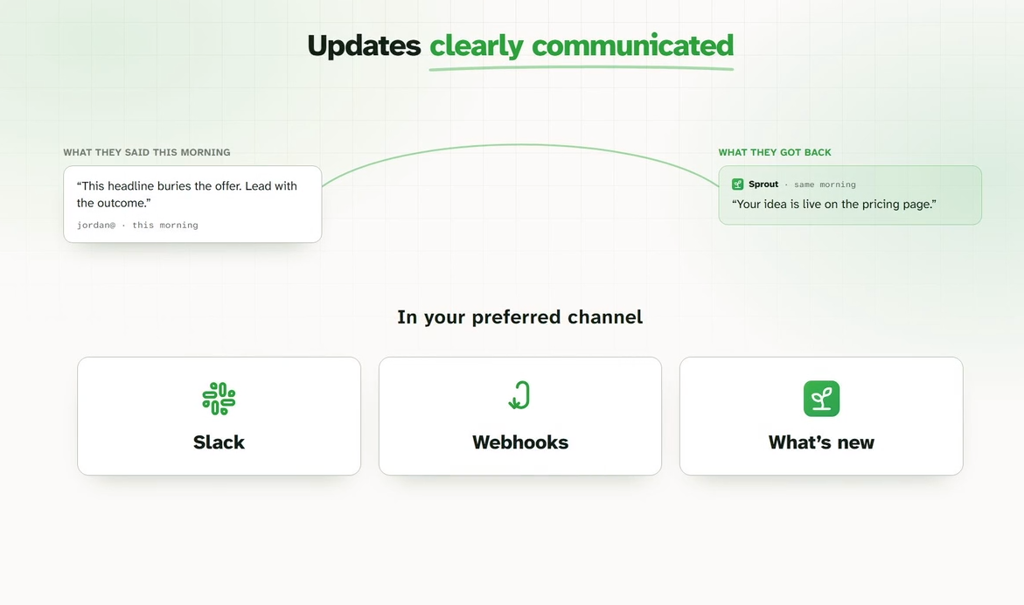
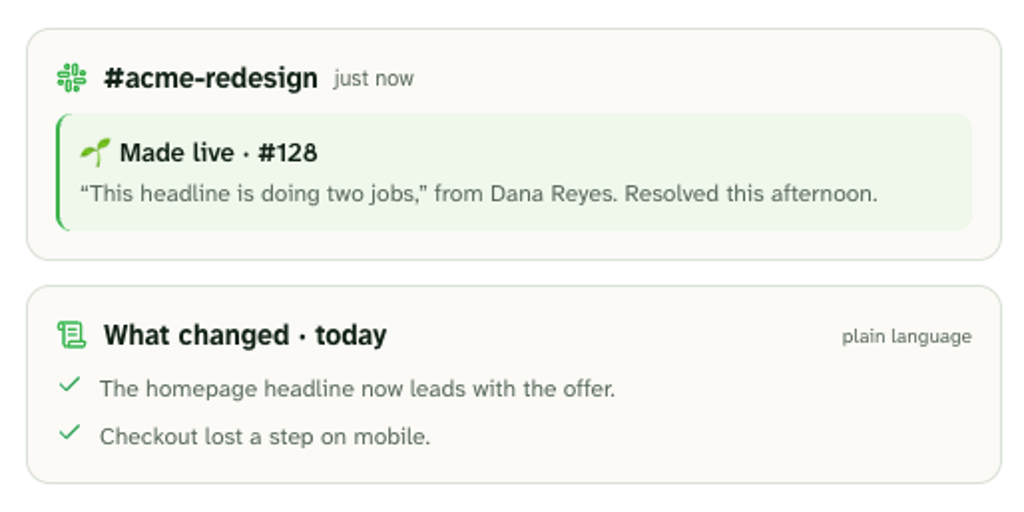
Deliver. The work reaches its audience the same day. Sprout writes up what changed, in plain language for everyone and in detail for your team, and posts it where your team already works. Nobody stops working to document what just happened.
Every Instruction Stays With the Expert Who Gave It
A note about a layout is a designer's call. A note about a sentence is a writer's. Sprout does not flatten those into one queue for one generalist to interpret. Direction lands on a board organized by project, named to the expert who gave it and the discipline it belongs to, so there is never a question whose call it was.
That matters more than it sounds. AI output usually feels slightly wrong when the direction behind it didn't come from someone with the relevant expertise.
We Built It for Ourselves First
Sprout has been running across MoJo Active's own product team and client engagements for months before today. Every capability in it exists because somebody here needed it on a Tuesday, never because it looked good on a roadmap.
Building it into our own work also meant connecting it to the AI our team already used, rather than asking anyone to adopt something new. Yours works the same way.
What Your Experts Could Do With an Afternoon
Every team keeps a list of things that would obviously improve the work and will obviously never happen. Some are too small to justify a day of somebody's time. Others are too big to justify the cost of trying. Both of those calculations just changed.
If you want to see what that looks like on your own work, sign up for a 14-day free trial.